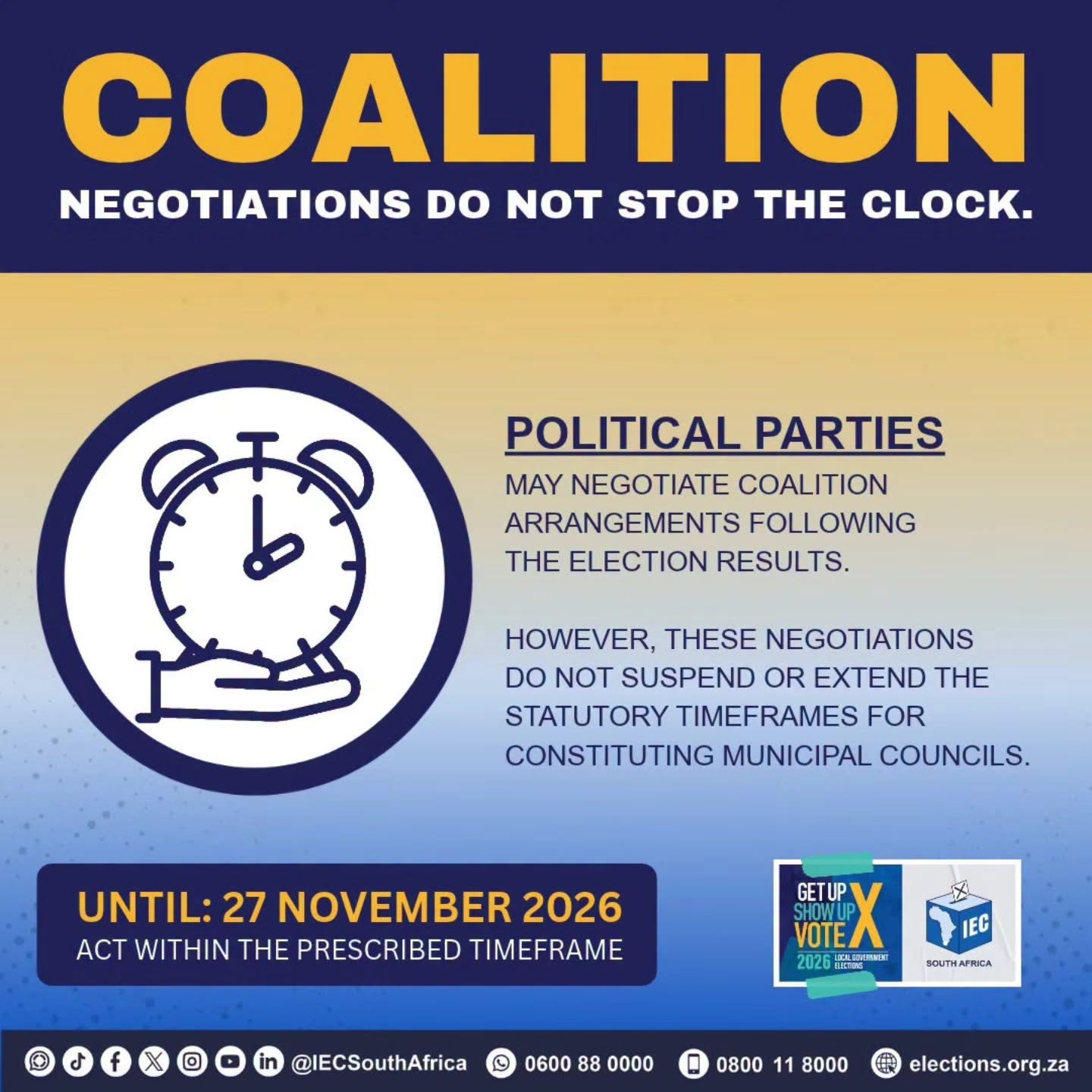
MPUMALANGA – The outcome of coalition negotiations in major metros such as Johannesburg, Tshwane, Ekurhuleni and eThekwini could determine who governs several municipalities in Mpumalanga, where the ANC has lost its outright majority in most councils.
With 14 of the province's 17 local municipalities now facing coalition governments, political parties are looking beyond provincial boundaries as national negotiations continue.
The ANC remains the largest party in Mpumalanga, but its support has dropped significantly. The party secured 43.7% of the provincial vote, representing 480 851 votes, compared to 58% in the 2021 local government elections.
The DA came second with 14.6%, followed by the EFF with 10.3%, the MK Party (MKP) with 9.5%, the Service Delivery Party (SDP) with 5.3% and the SACP with 3.8%.
The ANC secured outright majorities in only three municipalities: Bushbuckridge, Chief Albert Luthuli and Nkomazi.
In 2021, the party needed coalition partners in just three municipalities, Steve Tshwete, Govan Mbeki and Lekwa. Five years later, that number has risen to 14.
Among the hung councils, the SDP leads in Victor Khanye, while the MKP leads in Mkhondo. The ANC remains the largest party in the other hung councils, including the City of Mbombela, where it received 48.91% of the vote, followed by the DA with 14.02% and the EFF with 12.1%.
ANC provincial secretary Muzi Chirwa has already indicated that the province will take direction from the party's National Executive Committee (NEC) on coalition negotiations.
This means agreements reached at national level could influence which parties work together in Mpumalanga.
The ANC is reportedly in advanced discussions with the MKP, EFF and ActionSA over coalition arrangements in Johannesburg, Tshwane, Ekurhuleni and eThekwini.
The talks reportedly exclude the DA following disagreements over ActionSA's demand that Helen Zille should not become mayor of Johannesburg and Cilliers Brink should not return as mayor of Tshwane.
Under the proposed arrangement, ActionSA would lead Johannesburg and Tshwane, while the ANC would retain Ekurhuleni. An ANC-MKP partnership is also being discussed for eThekwini.
The DA has indicated that it is prepared to serve in opposition in Johannesburg, Ekurhuleni and Tshwane if it cannot secure coalition agreements.
Should the ANC-MKP-EFF-ActionSA arrangement succeed nationally, it could make it politically difficult for ANC negotiators in Mpumalanga to enter into agreements with the DA, even in municipalities where the two parties could form a majority.
In Steve Tshwete, the ANC holds 19 seats and needs another 11 to reach the 30 required for a majority. In Govan Mbeki, it has 23 seats and needs 10 more to reach 33.
In both municipalities, the ANC could secure a majority through partnerships with the MKP, EFF and SACP, parties involved in or aligned with the coalition discussions taking place nationally.
The DA, meanwhile, needs another 14 seats in Steve Tshwete and 15 in Govan Mbeki to reach a majority. Without support from the MKP or EFF, its options are limited.
An ANC-DA agreement would offer another possible route, although such a partnership could conflict with the direction emerging from national negotiations though cannot be ruled out.
SDP emerges as potential kingmaker in Victor Khanye
In Victor Khanye, the SDP, formed less than a year ago by former ANC figures, secured 39.53% of the vote, becoming the largest party amid growing frustration over water shortages, unemployment and poor service delivery.
The party has indicated its willingness to work with any party that prioritises service delivery, making it a potential coalition leader.
However, the ANC, DA and Our Last Hope (OLH), led by a former Victor Khanye council speaker, could also join forces to secure a majority, leaving the SDP out of government.
This shows that winning the most votes does not guarantee control of a municipality.
Mkhondo could challenge national coalition arrangements
Mkhondo presents a different political picture, with the MKP emerging as the leading party in the municipality, recording its strongest performance outside KwaZulu-Natal.
However, MKP elections manager in Mkhondo, Siphiwe Mathebula, has said the party would not work with the ANC, arguing that doing so would betray voters who rejected the governing party.
If the MKP maintains this position, the ANC may have to explore agreements with the DA, EFF, SACP or smaller parties, while the possibility of an MKP-led council remains.
Mkhondo could therefore become an important test of whether national coalition agreements can be applied across municipalities or whether local political differences will require separate arrangements.
Coalition talks intensify across the province
Coalition negotiations are expected to be particularly important in Mbombela, Emalahleni, Govan Mbeki, Steve Tshwete, Lekwa, Thaba Chweu, Victor Khanye and Mkhondo.
In Thaba Chweu, the ANC fell below 50% for the first time since 1995, ending 31 years of outright political dominance.
The party received 41.05% of the vote, down from 58.33% in 2021, while the DA secured 19.51% and the EFF increased its support to 14.78%.
These results have left political parties facing difficult decisions over which partnerships could deliver stable governments.
The question is whether the ANC will follow the coalition approach being discussed nationally or enter into separate agreements with parties such as the DA and SDP where local circumstances demand it.
Local negotiations already underway
The DA in Mpumalanga, led by provincial leader Jane Sithole, has already held discussions with the provincial leadership of the ANC and SDP.
The party says no agreements have been reached and that its Federal Executive will have the final say on any coalition arrangements.
Sithole has welcomed the election outcome, saying the failure of any single party to secure outright majorities in most municipalities creates opportunities for coalition governments.
The DA is also reportedly involved in national discussions with the EFF and MKP, despite previously ruling out cooperation with either party.
This reflects the uncertainty surrounding coalition negotiations, with parties exploring different options while awaiting decisions from their national leadership structures.
What this means for Mpumalanga
If the proposed ANC-MKP-EFF-ActionSA arrangement is concluded nationally, similar partnerships could emerge in several Mpumalanga municipalities, including Steve Tshwete and Govan Mbeki.
However, if national negotiations fail or local parties refuse to cooperate, municipalities could see different arrangements. These could include ANC-DA partnerships, an MKP-led council in Mkhondo or an SDP-led coalition in Victor Khanye. Minority governments could also emerge where parties fail to secure working majorities.
Mpumalanga Premier and ANC provincial chairperson Mandla Ndlovu has urged political parties to establish stable coalitions that put residents' interests first.
For residents, however, the real test will not be which party secures the mayoral position, but whether the new governments can deliver reliable water supplies, repair roads, improve basic services and remain stable over the next five years.