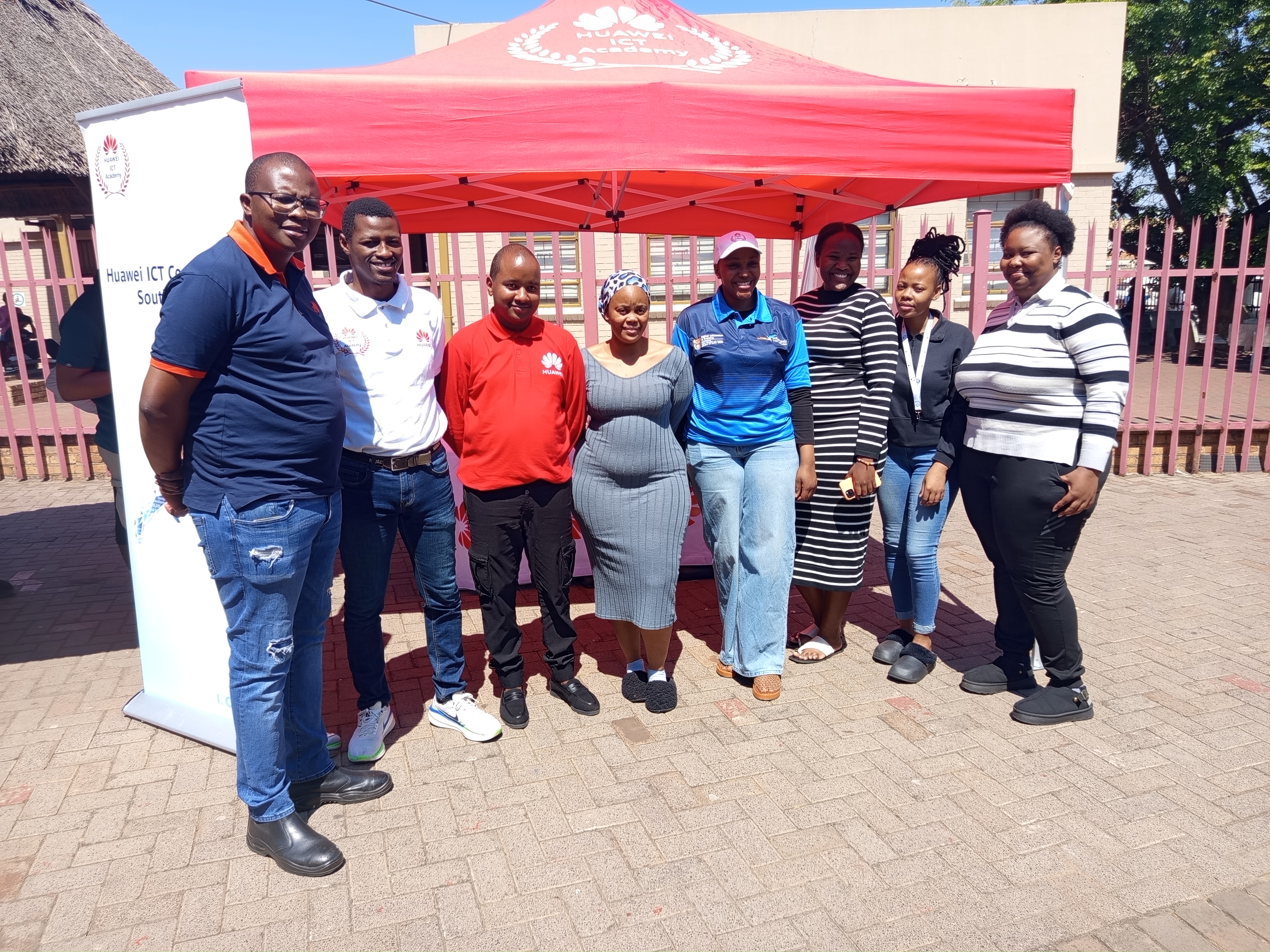
EMALAHLENI — Students at Nkangala TVET College’s Witbank Campus were introduced to emerging technology skills, certification opportunities and an international ICT competition during the Huawei ICT Roadshow on 16 September.
The roadshow formed part of Huawei ICT Academy’s efforts to reach students at selected higher education institutions and recruit participants for the 11th edition of the Huawei ICT Competition.
It also aimed to raise awareness of the skills and certification opportunities available through the academy.
Nkangala TVET College was among 15 higher education institutions selected for the roadshow. The college is also one of more than 80 institutions in South Africa working with Huawei ICT Academy, a collaboration between Huawei and higher education institutions aimed at strengthening links between education and the ICT industry.
The initiative comes as technologies such as artificial intelligence (AI), cloud computing, the Internet of Things (IoT) and 5G continue to influence workplaces and create demand for new technical skills.
Sakhile Mathaba from Nkangala TVET College’s Office of Innovation and Development said programmes such as the Huawei ICT Competition give students practical exposure to technologies associated with the Fourth Industrial Revolution (4IR).
“We normally hear people speak of 4IR, but at a practical level, we still don’t know what that is. So, obviously, it’s made up of different sets of skills, such as the Internet of Things, artificial intelligence, machine learning, cloud computing, and so on and so forth,” Mathaba said.
He explained that students who participate in the competition undergo training and develop technical competencies that can benefit them beyond the competition.
“Participating in competitions like this exposes the students to those skills because they have to undertake those trainings to be competent to participate in the competitions. But again, these are skills that will benefit them in their future endeavours in the place of work,” he said.
Mathaba said the exposure could also benefit students interested in entrepreneurship by helping them identify ways of using technology to develop or strengthen their businesses.
The Huawei ICT Academy provides students with access to courses and certifications in more than 20 technical areas, including AI and cloud computing. Its certification pathway includes HCIA at associate level, HCIP at professional level and HCIE at expert level.
The academy also aims to connect trained ICT talent with industry. Following certification, students’ details may be included in a talent pool used for Huawei ICT Talent Job Fairs, where opportunities can be matched with Huawei, its customers and partners.
Another focus of the roadshow was the Huawei ICT Competition, an annual global competition in which students test their theoretical knowledge, practical abilities and innovation skills.
The competition includes a Practice Competition, which assesses theoretical knowledge and practical skills, and an Innovation Competition, which focuses on applying technology and innovation through solutions incorporating Huawei technologies.
Participants progress through several stages, beginning with the preliminary stage, followed by the national stage in South Africa and the regional stage involving students from the Southern Africa region. Successful participants can ultimately reach the global final.
Students who qualify for the global final are sponsored by Huawei to travel to China to participate in the international event and engage with students from other countries.
For Nkangala TVET College, the initiative provides an opportunity to expose students to skills that reflect the changing demands of the technology sector.
Mathaba said the exposure was important for students seeking employment as well as those considering entrepreneurship.
“Those who are aspiring to entrepreneurship, they can still start businesses that are either powered by those technologies or they can start businesses that can benefit from those technologies,” he said.
He said the broader objective was to prevent students from entering the job market without exposure to current technologies.
“For the most part, it’s to expose students to the latest technology and also to align with what the tech industry is doing so that when they go to the job market at a later stage, when they are done with their studies, they don’t arrive there void of the latest tech skills,” Mathaba said.