KATJIBANE – An unsuccessful university application could have ended David M. Moima's dreams. Instead, it became the turning point that launched the self-taught Katjibane artist on a journey that is earning him recognition from traditional leaders and clients beyond his hometown.
Moima has built a reputation for producing strikingly realistic portraits using unconventional materials, including cardboard, toilet paper, plastic, window glass and charcoal from burnt wood. His story is one of resilience, determination and the belief that talent can flourish despite limited resources.
He attended Somabedlana Primary School before enrolling at Rakau Combined School and completed matric at Pungutsha Secondary School in 2023. Although he had hoped to continue his studies at university, his application was unsuccessful.
"I wasn't accepted to university, but that rejection didn't stop me. It pushed me to believe in my gift and build my own path," he said.
Moima's artistic journey began in May 2023 while he was still in matric. A sketch of one of the school's builders revealed his natural talent, and encouragement from those around him inspired him to draw a portrait of his friend, Martin Moreba.
"That was the moment I knew I wanted to take art seriously."
For Moima, portraiture is about more than capturing a person's appearance.
"A portrait can preserve a memory, honour someone who has passed away and make people feel seen. I realised I could use my hands to give people that feeling."
Without formal training, he refined his skills through constant practice and experimentation, often working with whatever materials he could find.
"I call it 'art from nothing' because I don't wait for perfect materials. I use what life gives me."
A detailed facial portrait usually takes three to four days to complete, while a full-body portrait can take up to a week. He said capturing a person's eyes, expressions and skin texture is the most challenging part of the process.
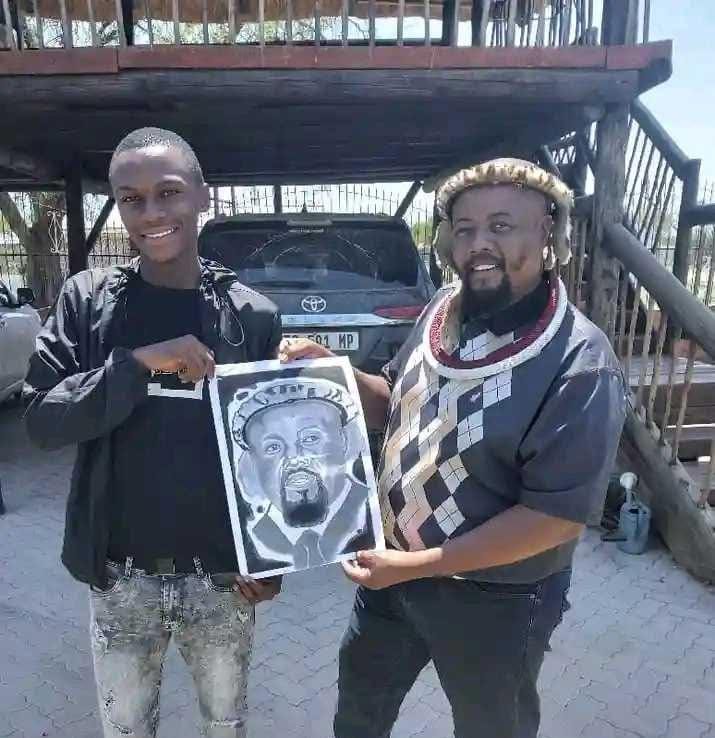
One of the defining moments in his career came when he presented a portrait of Ikosi C.M. Mahlangu II.
"My father passed away when I was in Grade 8. After I presented the portrait, Ikosi Mahlangu welcomed me like a son. He became a father figure and started supporting my journey. That changed my life."
His growing reputation also gave him the opportunity to present a portrait to the late Ingwenyama uMakhosonke II Mabhena of the Ndebele Kingdom at the Ndzundza Pungutjha Royal Authority.
Despite his growing success, Moima said limited financial support, the high cost of art materials and unpaid commissioned work remain major challenges.
"There were times I felt tired and broke, but when I think about my family's struggles, I remind myself that I'm the one who will help change our future."
He credits social media with helping him reach new audiences, attract commissions and grow his client base beyond his local community.
Inspired by renowned South African artist Nelson Makamo, Moima hopes to establish an art studio in Katjibane within the next five years. He wants to mentor aspiring artists, create employment opportunities and exhibit his work nationally and internationally.
Above all, he hopes his work will preserve stories for future generations.
"I want people, even 50 years from now, to look at my work and say, 'This is who we were. This is how we looked. This is how we felt.'"
Moima is appealing for funding and sponsorship to purchase professional art materials and expand his brand. He believes the right support will not only transform his future but also create opportunities for other young artists in his community. For Moima, every portrait is more than a drawing; it is a celebration of identity, heritage and the enduring power of African storytelling.