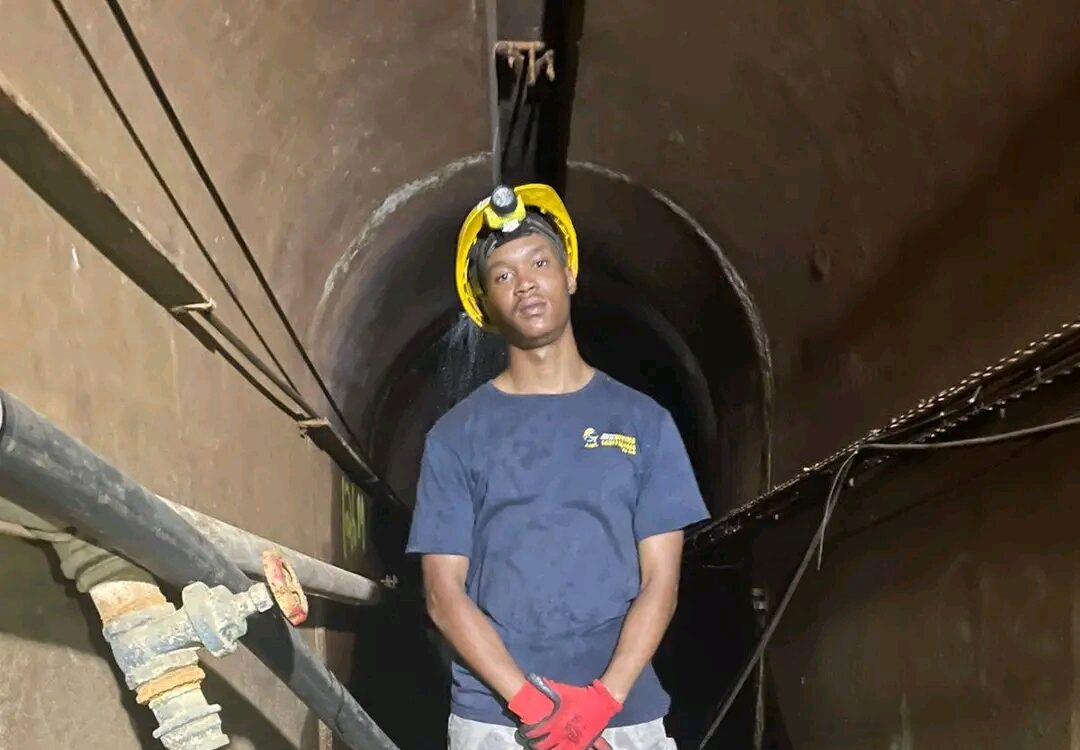
Tweefontein K — In a community where activities in large water bodies are unheard of, Nkululeko Lethuxolo Mashia, a 23-year-old from Tweefontein K under Thembisile Hani Local Municipality, has chosen a path that few in his community ever imagined: commercial diver.
Mashia pursued diving largely through his own research and determination. “Before diving I didn’t know anyone who worked in this field. It was me researching what I could do since I love swimming,” he says.
With just eight months of commercial diving experience, he has already worked on major inshore civil projects, handled heavy underwater machinery and learned to stay calm in environments most people fear.
Mashia’s journey began in primary school, where he discovered a love for swimming that soon grew into a calling. “I naturally fell in love with swimming at a very young age,” he says. “All I was thinking about after finishing school was to swim.”
That early passion led him into one of the demanding and least-known careers of commercial diving. After completing his Grade 12 at Prestige College, he went on to enrol at Mzansi Scuba Diving Academy where he enrolled for courses such as Open Water Diver, Enriched Air Nitrox, Deep Dive, Navigation, Night & Limited Visibility, Diver Stress & Rescue Theory.
He later enrolled at SEADOG Commercial Diving School in 2023, where he qualified as a Class VI Commercial Scuba Diver and Class III Commercial Surface Supply Diver. These qualifications allowed him to work with both scuba and surface-supplied diving equipment — a level of skill set that many divers take years to achieve.
Today, he works as an inshore commercial diver with South African Diving Contractors (S.A.D.C). Handling tasks such as removing and installing dam gates, sealing inlets and outlets, airlift dredging and jetting (2ich to 6ich), lifting and installing valves, underwater construction, cleaning, maintenance and inspection. The work is demanding, unpredictable and often dangerous.
“Every time you go in the water, you never know what you’re going to encounter,” he says, adding that he once found himself tangled in his diver’s umbilical, a multi-component lifeline that connects a diver to a support station on the surface.
Essentially, the ropes and pipes once created a knot, causing him to be trapped underwater. “In dams you find fish, crocodiles you don’t know what’s waiting for you at the bottom, your life is always in danger.”
Yet he continues to dive with courage and faith. “We prepare to dive by praying,” he says. “It doesn’t matter whether the dive is deep or shallow. You must respect the creator of the water.”
Commercial divers often work in complete darkness, in freezing temperatures, and under strict safety rules. Training is tough, demanding physical fitness, mental discipline and respect for safety. “You must be fit, take care of yourself and eat right. In order to make it in this field, just be disciplined.”
Mashia also learnt the critical role that commercial divers play in maintaining dams, reservoirs and water systems. “What I realised is that many dams were built 50 years ago and never maintained,” he says. “If they were maintained, communities wouldn’t suffer from water shortages.”
He believes more divers are needed in South Africa to clean pipelines, remove debris and inspect structures underwater. Divers also assist with search and recovery when required. “If there were divers on site, dams would last longer and be cleaner,” he adds.
One of his biggest learning experiences was a major installation in Nelspruit Dam. “I installed a six-tonne gate underwater,” he says. “First you take out the old gate system, build a hammer underwater (pressure shock) and then install the new system. I was working with six people, diving every day for 2–3 hours. Such tasks require teamwork, strength and technical skill.”
Back home, neighbours are surprised when they hear what he does for a living. “I always see people’s reactions. This is rare; you don’t see it every day. Even on TikTok the work that we do, it doesn’t just pop up.”
Mashia hopes to change that by making diving more accessible to young people. “I also want to open my own dive school later, recreational diving and swim coaching. I want to keep the industry alive. I’m willing to teach people this skill, but the resources are very slim.”


