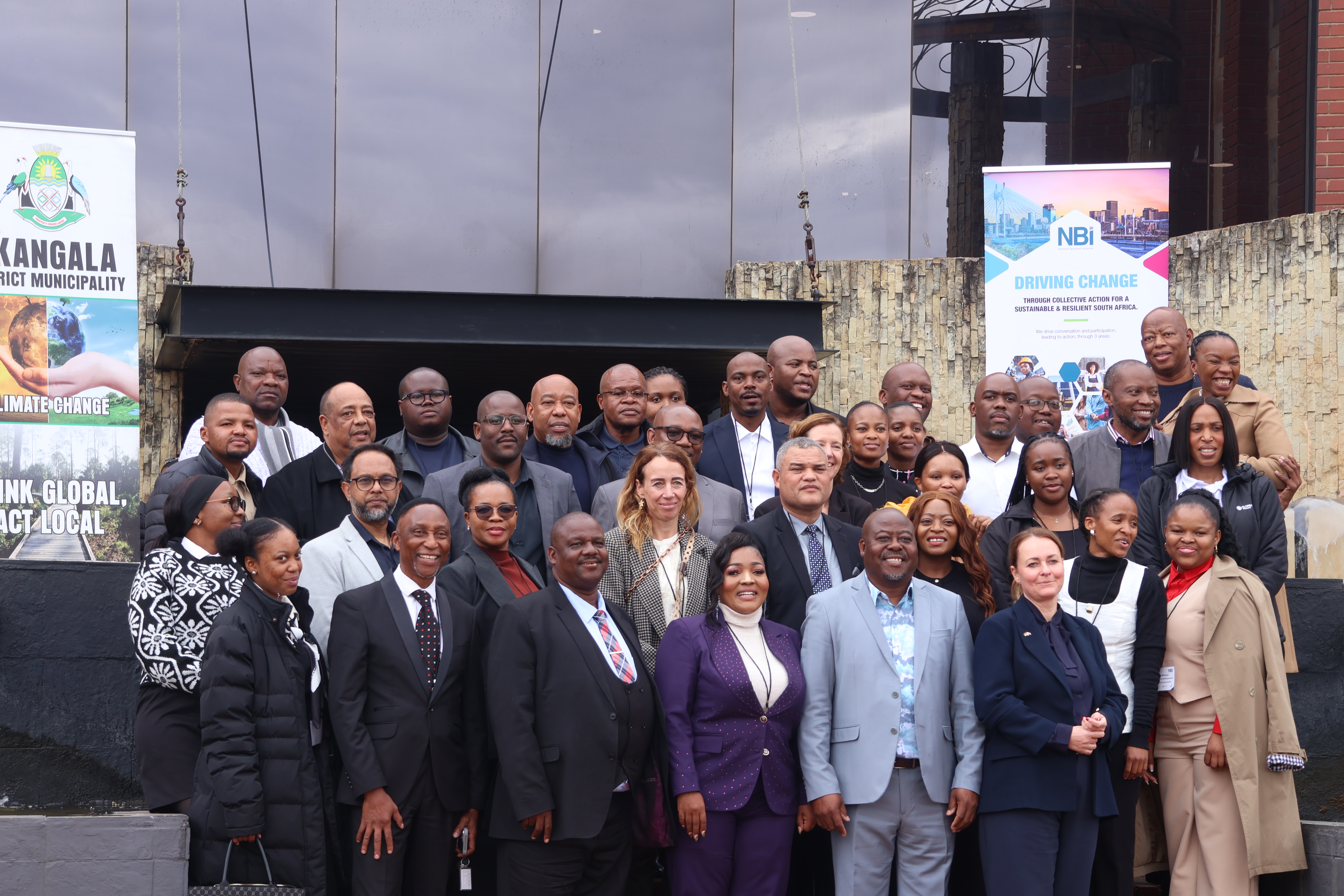
MIDDELBURG — Nkangala District Municipality, in partnership with the National Business Initiative, supported by the Department of Forestry, Fisheries and the Environment (DFFE), the Mpumalanga Green Cluster Agency and GIZ through the Just SA initiative, officially launched its Just Transition Programme in Middelburg on 22 May 2026 to help prepare communities and workers for South Africa’s shift towards a low-carbon economy.
The programme aims to strengthen institutional capacity, attract investment opportunities and diversify Nkangala’s economy through practical development plans focused on inclusive and sustainable growth.
Historically reliant on coal mining, power generation and related industries, Nkangala plays a major role in South Africa’s energy sector and is expected to undergo significant socio-economic changes as the country moves towards cleaner energy sources.
The district is home to eight coal-powered stations, including the now decommissioned Komati Power Station, where plans are already in place for repurposing towards green energy generation. The district currently supplies about 23.7GW to the country’s grid, accounting for more than a third of South Africa’s electricity generation and supporting approximately 150 000 jobs.
Acting Executive Mayor Taylor Pookgadi said the initiative marks the start of a coordinated district-wide implementation process.
“This engagement marks the beginning of a coordinated district-wide process to position Nkangala within South Africa’s evolving economic, energy and environmental landscape,” he said.
Pookgadi said the transition should be viewed as both an environmental and socio-economic necessity.
“It is not only about sustainability, but also about protecting livelihoods, reducing unemployment and poverty, and building resilient communities,” he said.
He further stressed the importance of coordinated investment to ensure communities benefit from the transition.
“We must channel resources and investments in a coordinated manner to ensure that the transition benefits our people and leaves no one behind,” said Pookgadi.
Mpumalanga Chief Director for Climate Change Services Philemon Mathebula said climate change is already affecting communities across the province.
“Climate change is no longer theoretical. It is being felt through rising temperatures and changing weather patterns,” he said.
Mathebula said increasing floods, droughts and cold spells are signs of broader climate disruptions largely caused by human activity.
“Carbon emissions from energy production and consumption are a key driver of global warming, which in turn disrupts weather systems,” he said.
He commended Nkangala District Municipality for taking proactive steps towards environmental protection and a greener economy.
The South African Local Government Association (SALGA) also outlined its role in supporting municipalities during the transition process.
SALGA Just Transition Specialist Babalwa Mbobo said the organisation is leading national coordination efforts.
“SALGA is constitutionally mandated to provide, promote and support municipalities. We are the lead institution of Chapter 10 of the Just Transition implementation plan,” she said.
Mbobo added that SALGA is prioritising municipal readiness assessments to strengthen implementation at local government level.
“The first work stream is looking at municipal capability, how ready our municipalities are when it comes to the Just Energy Transition. For municipalities that are struggling, we are working on addressing challenges that we identify,” she said.
She further revealed that financial and technical support programmes are already being introduced in parts of Mpumalanga.
“There is funding for a municipal utility reform programme where we are focusing on four municipalities in Mpumalanga. We will capacitate municipalities and ensure feasibility studies are conducted for projects,” said Mbobo.
The launch highlighted the importance of collaboration between government, business, labour, communities and development partners to ensure the transition remains inclusive and economically sustainable.