EMALAHLENI — Mpumalanga Premier Mandla Ndlovu has called for stronger accountability and improved victim support services in the fight against gender-based violence and femicide (GBVF), warning that violence against women and children remains one of the province’s greatest challenges.
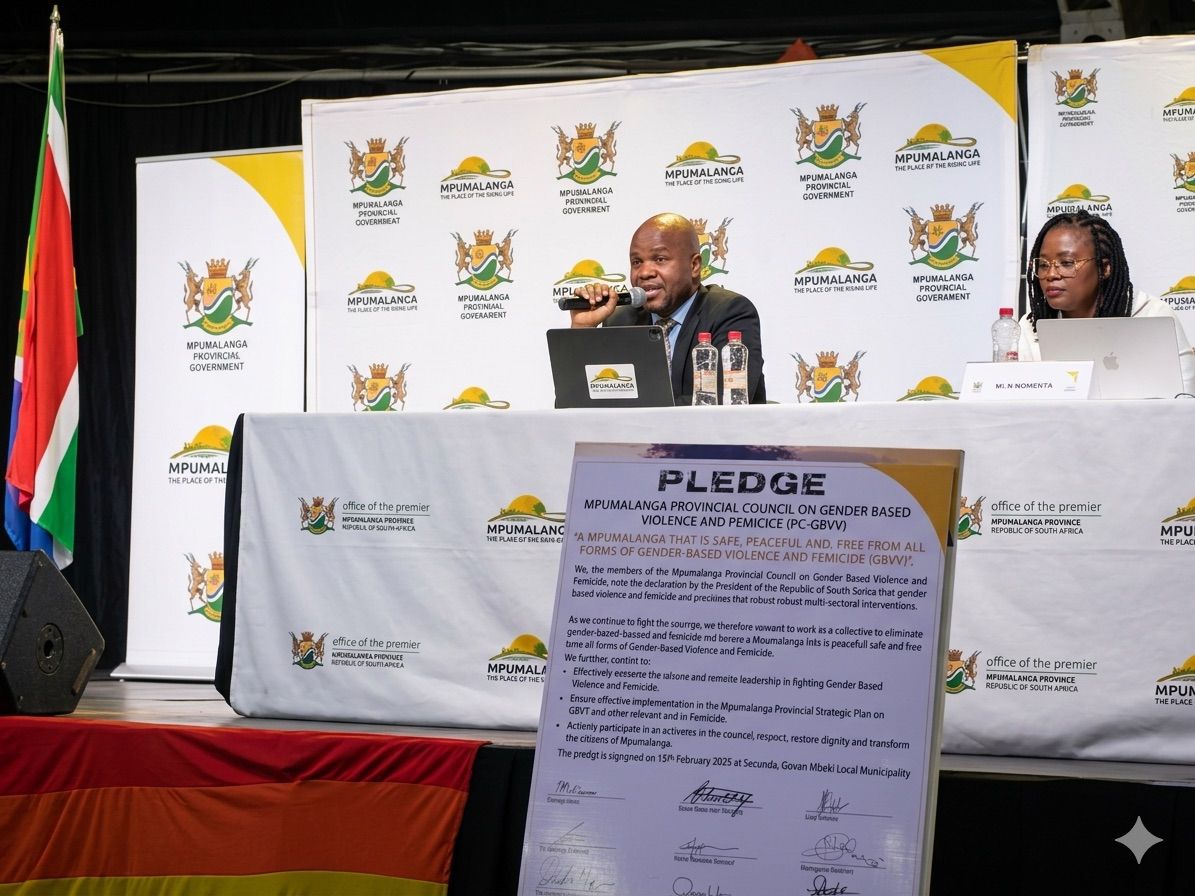
Ndlovu was speaking during the Provincial Gender-Based Violence and Femicide (GBVF) Council meeting held at The Ridge Hotel in eMalahleni on 26 May 2026, where government leaders, law enforcement agencies, traditional leaders, the National Prosecuting Authority (NPA), civil society organisations and other stakeholders assessed progress and identified critical gaps requiring urgent intervention.
“As leaders, we cannot normalise this violence. We cannot become comfortable with statistics while our people continue to live in fear. Every victim represents a life interrupted, a dream shattered and a family traumatised,” said Ndlovu.
He stressed the importance of educating young people about consent, gender equality and healthy relationships to prevent violence across generations.
Speaking to the Highveld Chronicle after the meeting, Ndlovu acknowledged that while progress had been made since the establishment of the Provincial GBVF Council, the province was still far from achieving its goals.
“It will be very difficult for me to say yes or no because the only time we will say we are doing our work is when we win the fight against GBVF in the province and the country,” he said.
“While we continue to witness women and girls being killed by relatives, fathers, stepfathers, uncles and intimate partners, it remains a serious concern for us.”
The meeting also reviewed the implementation of resolutions adopted during the previous council sitting in November.
Progress reports on the Provincial Strategic Plan on GBVF showed that only 35 of 60 government indicators were achieved, resulting in an implementation rate of 58%.
Although awareness initiatives and school safety programmes exceeded expectations, several targets were not achieved due to resource limitations and funding constraints.
“We don’t think that 58% is enough. There is room for improvement. Some of our targets were ambitious because we wanted to deal with this scourge urgently, but we can say that we are trying and there are signs that we may win this war,” said Ndlovu.
A presentation by the South African Police Service (SAPS), delivered by Acting Provincial Head of the Family Violence, Child Protection and Sexual Offences (FCS) Unit Penuel Smith, revealed that Mpumalanga recorded 552 GBVF-related cases between January and March 2026, resulting in 277 arrests.
During the same period, courts handed down three life sentences, while other offenders received substantial prison terms, including 115 years for offences attracting sentences above 20 years, 216 years for cases carrying 10-year sentences, and 43 years for offences resulting in sentences between one and nine years.
Smith said the FCS Unit operates through 15 specialised units across Mpumalanga’s three district municipalities, with about 200 personnel dedicated to GBVF-related matters.
He added that specialised investigative divisions use DNA technology to identify repeat offenders and connect unresolved cases.
Police also acknowledged challenges, including under-reporting of crimes, delayed reporting by victims, social stigma and victim-blaming attitudes that discourage survivors from seeking assistance.
Ndlovu expressed concern over the arrest statistics.
“I was not comfortable that out of more than 550 reported cases, only about 51% resulted in arrests,” he said.
“These criminals are living among us. Communities must provide information to the police because if they are not arrested, it means we are not safe. These people belong behind bars.”
Mokgadi Makata from the NPA’s Sexual Offences and Community Affairs (SOCA) Unit said Mpumalanga currently has six Thuthuzela Care Centres located in Kabokweni, Tonga, Rob Ferreira, Witbank, Secunda and Ermelo.
The centres provide counselling, medical support, statement-taking and forensic services under one roof to minimise further trauma for survivors.
Makata said additional centres are planned for Bushbuckridge, Mkhondo and Middelburg to improve accessibility.
Civil society organisations, represented by Phumzile Ngodela, criticised the gap between awareness campaigns and implementation.
Ngodela said frontline organisations continue operating with limited financial and institutional support despite assisting victims and communities directly.
She highlighted delayed service delivery, fragmented referral systems, shortages of social workers and counsellors, and insufficient support for community-based initiatives.
Ngodela also raised concerns that men, boys and street-involved youth are often excluded from support programmes.
“Communities are tired of awareness without implementation. Communities are tired of reporting without receiving support. Communities are tired of promises without accountability,” she said.
Ndlovu acknowledged concerns about shortages of forensic social workers, nurses and counsellors.
“If we are saying we want to reduce GBVF in the province, we must appoint more nurses, more counsellors and more social workers. We are going to pay special attention to that,” he said.
“We cannot convene meetings, adopt resolutions and then fail to implement them.”
Several resolutions were adopted to strengthen the province’s response to GBVF, including establishing functional referral pathways between police, healthcare institutions and social services to ensure survivors receive coordinated support.
Stakeholders also called for inclusive psychosocial support programmes for men, boys and vulnerable youth, improved funding models for grassroots organisations, strengthened Rapid Response Teams across municipalities, and increased investment in shelters and survivor support services.
Ndlovu announced plans for intensified awareness campaigns and community outreach programmes aimed at encouraging the reporting of GBVF cases.
The government also plans to strengthen collaboration with municipalities, political structures and communities through awareness drives and door-to-door campaigns.
“We want a situation where a girl child can go to school, study late and return home safely,” he said.
Stakeholders agreed that meaningful progress against GBVF would require stronger coordination, sustainable funding, community participation and accountable implementation.